Eco Eaters (Case Study)
Project Type
UI/UX Design and Research
Date
May 2021 - August 2021
Team Size
6
Tools/Software
Figma, Canva
Role
UI/UX Design and Research
Our primary focus of this project was to combat food waste in the restaurant industry by designing a menu that is informative, yet non-intrusive to the dining experience.
The Problem
Food wastage occurs in every step of food production, from farming to plating. Our main objective was to create a design that would help reduce food waste in the restaurant industry, specifically in small businesses and restaurants.
Narrowing the Problem Space
Gathering Data on Stakeholders
We interviewed stakeholders involved in our problem space; restaurant owners, managers, and employees. Through these stakeholders, we were able to obtain a substantial amount of qualitative data. We collected information regarding their attributes, behaviors, preferences, feelings, attitudes, options, and knowledge about food waste in the restaurant industry.
We also handed out surveys to a larger population size, which included non-restaurant industry participants. The survey consisted of both open and close-ended questions through checkbox questions, Likert and ranking questions, and open responses. The purpose of the survey was to gather an understanding of the relationship between food service workers and food waste, as well as to narrow down the issue of food waste within the industry. Using a mixed method for our research allowed us to gather both qualitative and quantitative data to draw purposeful data from the stakeholders.
Survey Results
Of the survey participants, 81.3% of participants agreed that food waste was a moderate to severe issue within the restaurant industry, suggesting that food service employees are aware of the issue of food waste within the restaurant industry. 68.8% of participants expressed that their workplace’s food reduction policies were either non-existent or inadequate and the same percentage of participants also answered that they have little to no power over implementing new policies. 68.4% of participants reported that customers not finishing their meals was the main source of food waste. Overall, employees are aware of food wastage but are not given the proper knowledge, training, or resources to combat the issue.
Interview Findings
-
Oftentimes, it is the responsibility of the restaurant owner or manager to manage inventory and carefully make decisions on restocking. An understocked shelf may lead to unavailable menu items, thus leading to unhappy customers. An overstocked shelf can easily lead to food waste, which means a loss of money.
-
For restaurant owners and managers, saving money is a major motivator for reducing food waste.
-
Many restaurant employees agreed that most food wastage witnessed was done by customers, who left food on plates and tended to not ask for take-out containers.
-
There is no one-size-fits-all portion size for customers.

Key Takeaway
Based on the survey and interview results, we decided to narrow down our problem space to customer food waste. A majority of participants agreed that customer food waste was the main reason food was thrown out within the restaurant. Additionally, interviewees felt that although customer food waste was a big problem, it was a sensitive and challenging problem to solve.
Usability Goals
-
Accessibility - Customers should be able to access and use the design with ease.
-
Speed - The design must keep up with the quick pace of restaurant settings. The design should efficiently communicate information without unnecessarily taking customers' time.
-
Flexibility - The design should be accessible and appropriate for varied restaurant settings.
-
Cost-Effectiveness - The design should be low-cost to implement for restaurant owners. It is designed to reduce the amount of food wasted, but should not come at a cost of implementation.
-
Transparency - The overall goal of the design to reduce food waste should be communicated clearly to the customers.
Initial Prototypes
Prototype 1: Napkin Holder Infographic
We designed an informative flyer that would be displayed in restaurant napkin holders. The infographic contains environmental facts, designed to bring awareness to the issue of food waste. It also offers suggestions on how the customer can reduce food waste at the restaurant. The bottom of the infographic contains a message to notify servers, who may give customers an incentive to follow food waste reduction strategies. This incentive may be decided by the restaurant owner in the form of a coupon, small discount, etc.

Storyboard

-
Josh and his friend are starving and decide to go to a diner.
-
Josh is excited to eat and expresses that he is going to order a massive amount of food.
-
A server comes by to take Josh and his friend’s orders.
-
The server asks them if they have read the infographic on the napkin holder.
-
Josh and his friend take time to read the napkin holder infographic. Josh changes his mind after reading the infographic and decides to order a more reasonable portion.
Potential Issues
-
Poor visibility: There is no guarantee that customers will read the napkin infographic. Customers may likely not pay any attention to the napkin holder. Although servers may instruct them to read the infographic, some servers may not feel comfortable doing so.
-
Lack of flexibility: Not all restaurants have napkin holders. Napkin holders may not fit the aesthetic of certain restaurants.
-
Vague Incentive: A major part of this design is a customer incentive. The meaning of the incentive is vague here; do customers get an incentive every time? This would likely not be cost-effective. Restaurant owners may be deterred from this design if they must offer an incentive.
Prototype 2: Loyalty Card
The second prototype is a rewards card targeted towards restaurant dine-in customers. Customers would be given a card with a total of 10 slots and can earn points given in the form of stickers. Customers can earn points by leaving the restaurant with a clean plate whether through eating the full meal or taking the leftovers home in a to-go box. Upon filling an entire card, customers are rewarded with a discount coupon or free item that can be used or obtained in the future


Storyboard
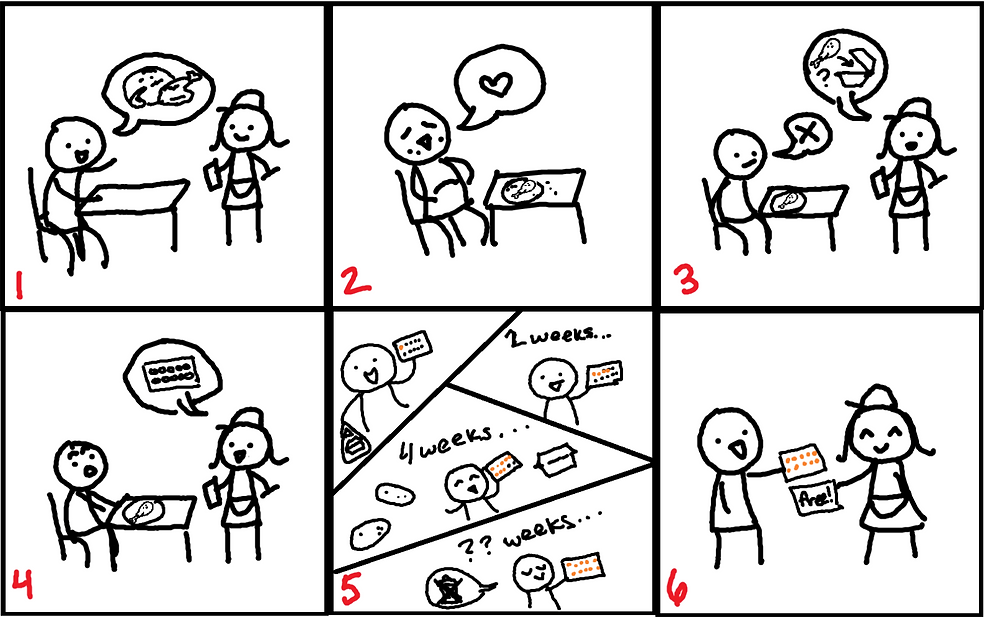
-
Rick orders a whole fried chicken.
-
Rick is full and satisfied, but does not finish his meal. He leaves one chicken leg on his plate.
-
A server comes by asking Rick if he would like a to-go box for his leftovers. Rick declines.
-
The server notifies Rick of the Clean Plate Card and explains that for every finished plate or to-go box he requests, he gets one point on the card. With ten points, he can get a free fried chicken meal coupon.
-
Rick accepts the offer and goes home with the to-go box and a point on his Clean Plate Card. Over the course of the next few weeks, he accumulates enough points to earn the reward.
-
Rick shows the server his finished Clean Plate Card and she gives him a free fried chicken meal coupon.
Potential Issues
-
Potential to encourage unhealthy eating habits: Some customers may feel pressured to finish all their food when they are already full.
-
Lack of information: A card does not leave space for valuable information, therefore lacking transparency. Although customers may be encouraged to reduce food waste, we wanted a design that was also educational.
Final Design Features & Justification
For our final prototype, we decided to design an informative placemat menu.
-
Placemat Menu: We decided to design a reusable placemat menu, aimed at dine-in customers. Since customers will always view menus, displaying information on them increases visibility. Because the menus are reusable, they are environmentally friendly and cost-effective for restaurant owners. Unlike napkin holders, placemat menus can be utilized in a variety of restaurant settings. This medium achieves our accessibility, speed, flexibility, and cost-effectiveness goals.
-
Infographic: An infographic communicates our purpose and encourages customer decision-making, thus meeting our transparency goal. The front of the menu contains food waste facts and food waste reduction strategies, similar to our Napkin Holder prototype. We also promoted non-profit organizations aiming to reduce food waste.
-
Menu Key: Many menus contain symbols to indicate dishes that are gluten-free, vegetarian, spicy, etc. We decided to use this approach for communicating portion sizes. By utilizing portion size indicators, customers are less likely to over-order and waste food.

